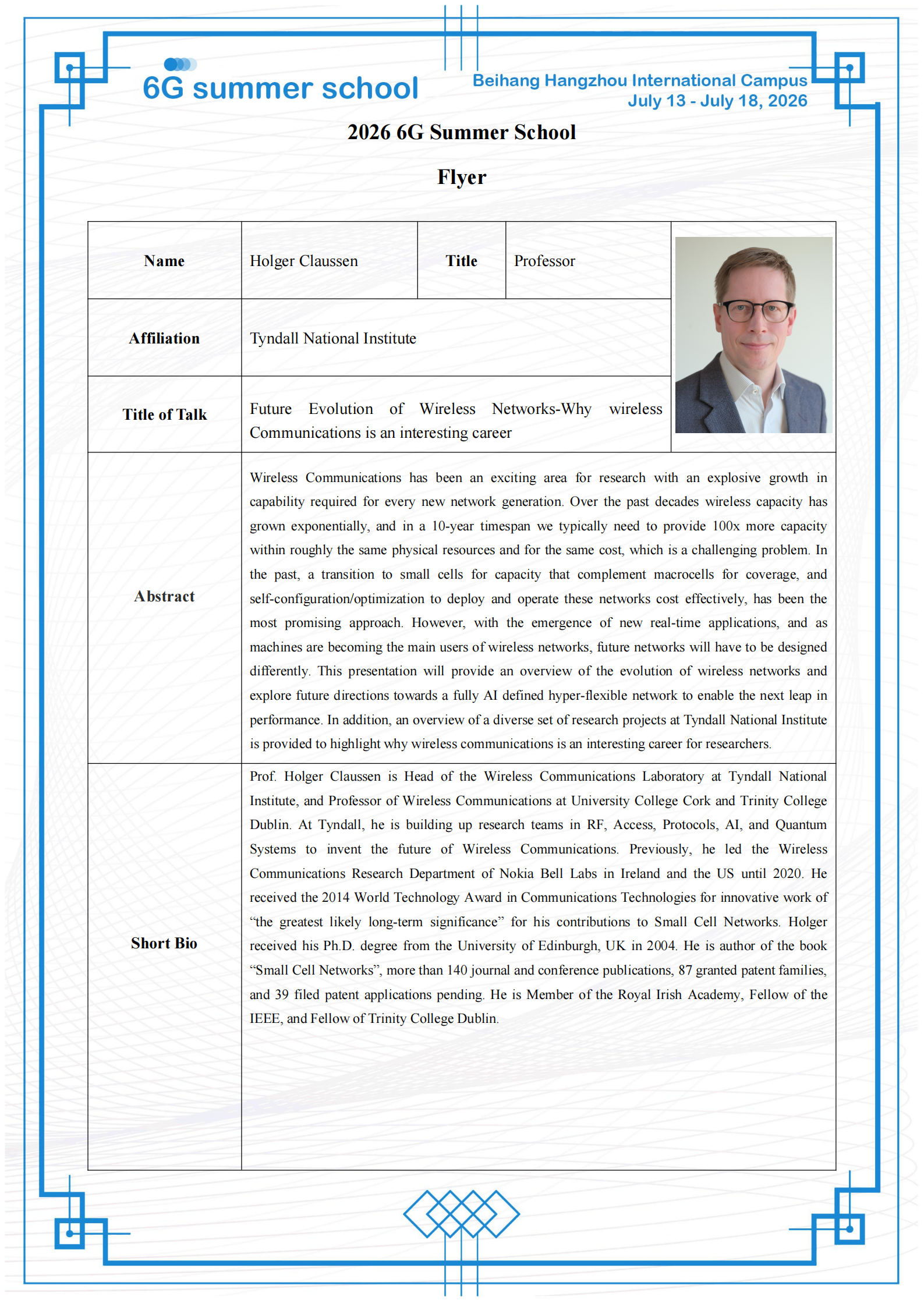
Holger Claussen
Tyndall National Institute
Title: Future Evolution of Wireless Networks-Why wireless Communications is an interesting career
Abstract:
Wireless Communications has been an exciting area for research with an explosive growth in capability required for every new network generation. Over the past decades wireless capacity has grown exponentially, and in a 10-year timespan we typically need to provide 100x more capacity within roughly the same physical resources and for the same cost, which is a challenging problem. In the past, a transition to small cells for capacity that complement macrocells for coverage, and self-configuration/optimization to deploy and operate these networks cost effectively, has been the most promising approach. However, with the emergence of new real-time applications, and as machines are becoming the main users of wireless networks, future networks will have to be designed differently. This presentation will provide an overview of the evolution of wireless networks and explore future directions towards a fully AI defined hyper-flexible network to enable the next leap in performance. In addition, an overview of a diverse set of research projects at Tyndall National Institute is provided to highlight why wireless communications is an interesting career for researchers.
Short Bio:
Prof. Holger Claussen is Head of the Wireless Communications Laboratory at Tyndall National Institute, and Professor of Wireless Communications at University College Cork and Trinity College Dublin. At Tyndall, he is building up research teams in RF, Access, Protocols, AI, and Quantum Systems to invent the future of Wireless Communications. Previously, he led the Wireless Communications Research Department of Nokia Bell Labs in Ireland and the US until 2020. He received the 2014 World Technology Award in Communications Technologies for innovative work of “the greatest likely long-term significance” for his contributions to Small Cell Networks. Holger received his Ph.D. degree from the University of Edinburgh, UK in 2004. He is author of the book “Small Cell Networks”, more than 140 journal and conference publications, 87 granted patent families, and 39 filed patent applications pending. He is Member of the Royal Irish Academy, Fellow of the IEEE, and Fellow of Trinity College Dublin.